

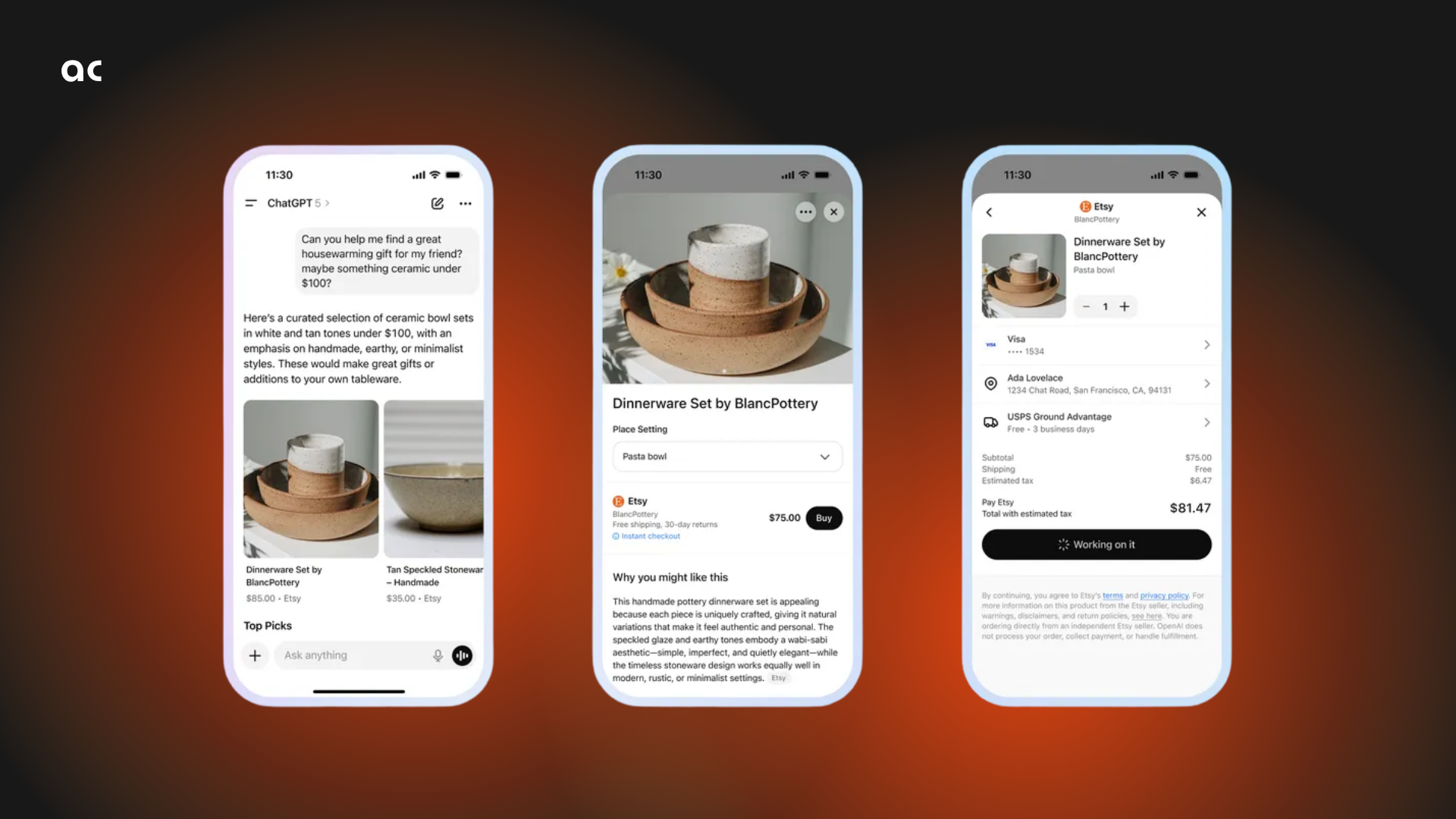

On 15 August, OpenAI Ireland notified Free and Go users across the EEA and Switzerland that ads will start appearing in ChatGPT later this month.
The ad sits below the answer, visually separated and labelled as sponsored. Turn that sentence around and you find the real news for retailers. The answer sits above the ad. And in a shopping conversation, ChatGPT assembles that answer from product data.
What was announced on 15 August
Ads in ChatGPT reach the EEA and Switzerland later this month, for users on the free tier and on Go. Four details that matter:
- The format is a sponsored block below the answer. The notice mentions no product carousels, which have been running in the United States since early August.
- Targeting is contextual: conversation topic, general location and device type. There are no keywords to bid on.
- Advertisers steer with context hints instead, a plain-language description of the conversation they want to appear in.
- OpenAI's own wording is "the EEA and Switzerland". Circulating summaries sometimes quote a different market count. Stick to OpenAI's wording.
This is not a niche audience. OpenAI's DSA filing reports an average of 159.1 million monthly EU users of ChatGPT search over the six months to 31 March 2026. In the Netherlands, ChatGPT accounted for 77.48% of AI chatbot use in July 2026 (StatCounter).
Why the placement matters more than the format
The ad sits below the answer. That makes the answer your real competitor, not the block underneath it.
On a search engine you compete for a position in a list of pages. In a shopping conversation you compete to be named in a comparison of products. ChatGPT pulls brand, price, availability and attributes from somewhere. Where that comes from decides how you appear in it. Or whether you appear at all.
And that traffic is worth more than average: retail traffic arriving through AI converted 54% better in May 2026 than traffic from other sources (Adobe Analytics).
Feed or page: the difference in numbers
Profound analysed more than a million shopping offers in ChatGPT in June 2026, comparing products that arrived through a product feed with products ChatGPT had to scrape from a web page.
- Brand, image and merchant details populated: 100% for feed products, 0% for scraped products.
- The "best price" tag: 100% against 21%.
- The share of feed products in what ChatGPT retrieved went from 4.3% to roughly 20% in six weeks.
Same catalog, a different route in, a completely different presence.
Note the sample. This is a June snapshot weighted towards the United States. The direction is firmer than the exact figure.
Where Europe stands right now
You cannot submit a product feed to OpenAI here today. OpenAI's own documentation says feed onboarding is currently available to approved partners only, and we have not been able to find a European retailer running live.
In practice that means ChatGPT learns your catalog here by reading your pages. That is exactly the 0 percent column.
The buy side starts small too. WPP Media, a launch partner for this rollout, wrote on 6 August: "Starting at the end of August, we will begin the first tests in the Dutch market." Customers meet the format before most advertisers can buy into it.
Two weeks is enough to build a media plan. It is not enough to clean up a catalog. Only one of those has a lead time.
One file, read twice
In OpenAI's specification, the ad and the organic product answer are fed by the same file.
From OpenAI's developer documentation: ads feeds "use the same base schema and add one per-product eligibility requirement".
One field, is_ads_eligible, separates your ad from the answer above it. So paid and organic are not two disciplines to align. They are one dataset, read twice.
The requirement is the same elsewhere. Google AI Mode reads Merchant Center. Microsoft made its UCP-ready feeds generally available in April 2026. Perplexity runs its own merchant program. Four specifications, one requirement: a complete, factual, current product record.
That pattern is not new. Google Shopping ran on a feed from day one, and the winners were rarely the highest bidders. They were the ones whose title, GTIN, price and stock were right. Marketplaces repeated the story. Now it repeats again, except the reader is working through a conversation instead of a search query.
What you can do this month
Submitting is not an option yet. Making sure the page ChatGPT reads tells the same story a feed would is. Five steps:
- Take a baseline. Ask ChatGPT about three of your best-selling products and note whether you get named, whether the price is right and whether the brand is correct.
- Fill in the fields every spec requires: title, brand, GTIN, price, currency, availability, condition, an image URL and a landing page that works.
- Rewrite product copy into facts. OpenAI's own guidance is "Use concise, factual copy that helps users understand products". "Timeless elegance, crafted with care" describes no product.
- Make price and stock on your page match what sits in your feeds. The gap between those two is exactly where an answer engine penalises you.
- Handle the repeat. OpenAI's feed specification assumes a refresh every fifteen minutes. An answer engine re-reads you continuously, so a catalog that was right in June is not automatically right in September.
Publishing is the easy part
This is exactly the problem Automated Commerce was built for. Not the publishing itself, because that is the easy part.
One catalog as the source. Missing fields get filled, copy and translations come out of that same product data, and everything goes out as one record to your webshop, your marketplaces and your feeds. Then it keeps running: the platform spots when a channel drifts from your source and pulls it back.
Because that is what changes now. Publishing a page used to be an event. Being right on every channel every day is work.
Ask ChatGPT this afternoon about what you sell. Do you get named, and is your price right?