

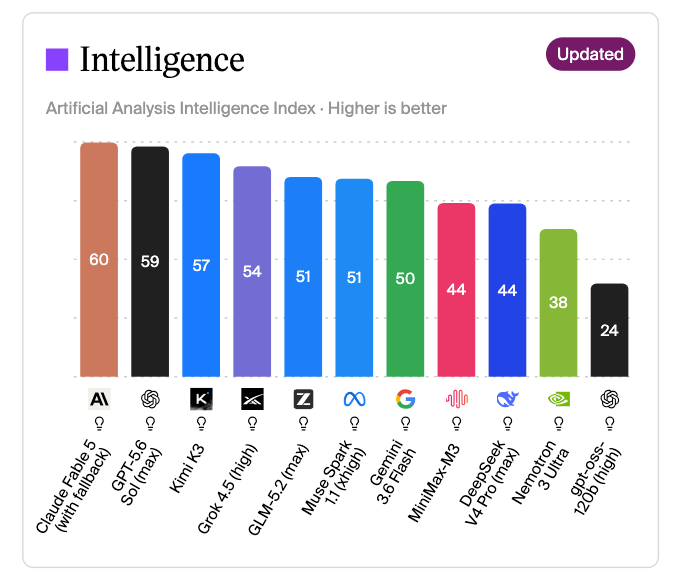

Kimi K3 is closing in on Claude and GPT. On the Artificial Analysis Intelligence Index (July 2026) it scores 57, against 60 for Claude Fable 5 and 59 for GPT-5.6 Sol. The gap between open source and the absolute frontier has never been this small.
For retailers building on AI, this is more than model news. It shapes how an AI foundation should be built: not around a single model, but around a mix of models, each doing the work it is best at.
What Is Kimi K3?
Kimi K3 is the new flagship model from Chinese AI lab Moonshot AI. At 2.8 trillion parameters, it is the largest open-source model ever announced. Moonshot has stated it intends to release the weights; at the time of writing they are not yet public.
The benchmark scores stand out. On AA-Briefcase, the agentic benchmark from Artificial Analysis, Kimi K3 ranks second, behind only Claude Fable 5. On the LMArena Frontend Code Arena it ranks first. For an open-source model, that is new territory.
Why This Matters Now
The frontier lead is shrinking faster than most teams expected. A year ago, the difference between open source and the top models was a class apart. Now an open-source model sits three points below the number one on the Intelligence Index.
For context: Kimi K3 does not beat the frontier models across the board. On the Intelligence Index it stays below Claude Fable 5 and GPT-5.6 Sol. But in specific areas, such as frontend code and agentic work, it already sits among or above the top. That is exactly what commoditisation looks like: not one big leap, but task by task.
More important: the open-source ecosystem is catching up on capability faster than on pricing. The question shifts from 'which model is best' to 'which model is good enough for this task, at what price'. That is a procurement question, not a technology question. And procurement questions are the kind retailers answer better than anyone.
What Kimi K3 Does Not Solve
Kimi K3 does not solve the cost problem. On the AA-Briefcase benchmark it costs $10.57 per task (Artificial Analysis, July 2026). That is frontier pricing for a model that stops just short of the frontier.
It is not fast either. On complex tasks, Kimi K3 is slow on average. And for reasoning-heavy work, like interpreting messy supplier data or making catalog decisions, frontier models still earn their price.
What This Means for Retailers Building on AI
The lesson is not to switch to Kimi K3. The lesson is that the model layer is commoditising, and an AI setup should be built for that.
- The cost advantage sits with smaller open-source models such as Kimi K2.5, DeepSeek, Qwen, and Gemma, ideal for volume work like product descriptions and translations.
- Frontier models remain worth their price for complex steps: data interpretation, catalog structure, and hard edge cases.
- Capability commoditises faster than price, so routing per task lowers cost structurally for the same output.
- One model for everything means overpaying on simple tasks, or giving up quality on hard ones.
The Winning Stack Is a Mix
The winning stack is a mix, not a single model. Treating the model layer like an organisation, with the right model on the right task, wins on cost and on quality at the same time.
The model layer is commoditising. Combining the right models for the right tasks is key. A bit like managing an organisation, only this one is made of agents.
This is exactly the principle Automated Commerce is built on. The platform routes every task to the model that is strongest and most cost-effective for it: product descriptions, translations, image analysis, catalog import. When the landscape shifts, the model changes under the hood. The only thing that changes for your team is the result and the cost, not the way of working.
What You Can Do Now
Retailers know this pattern. When marketplaces took off, the winners were not the sellers who guessed the right channel in year one. They were the sellers whose product data was structured well enough to move with whichever channel won. The same applies to AI models: the model is replaceable, your structured product data and the orchestration around it are not.
So the question is not which model to pick. The question is whether your AI setup can switch models per task, without a rebuild.
How much of your AI work runs on a single model today, and what happens to your cost per product when the landscape shifts again next quarter?