Your new collection is ready. The photos are in, the prices are right. Only the copy is missing: 400 products, with the supplier's text or half a sentence from last season.
A good SEO product description says what makes this product different, in the words your customer searches with. For that you first need correct product data, and then clear agreements on how your brand sounds. Here is how to write them for your whole catalog.
What is good SEO product copy?
Product copy has three readers. Your customer wants to know whether this product fits. Google wants to understand what the page is about. And AI assistants increasingly take the answers they give shoppers from it.
All three need the same thing: concrete, correct information. Google says so itself: write helpful content for people, with information they cannot already find everywhere. Your supplier's text probably sits on ten other webshops too, and gives nobody a reason to buy from you.
What does good product copy look like? An example
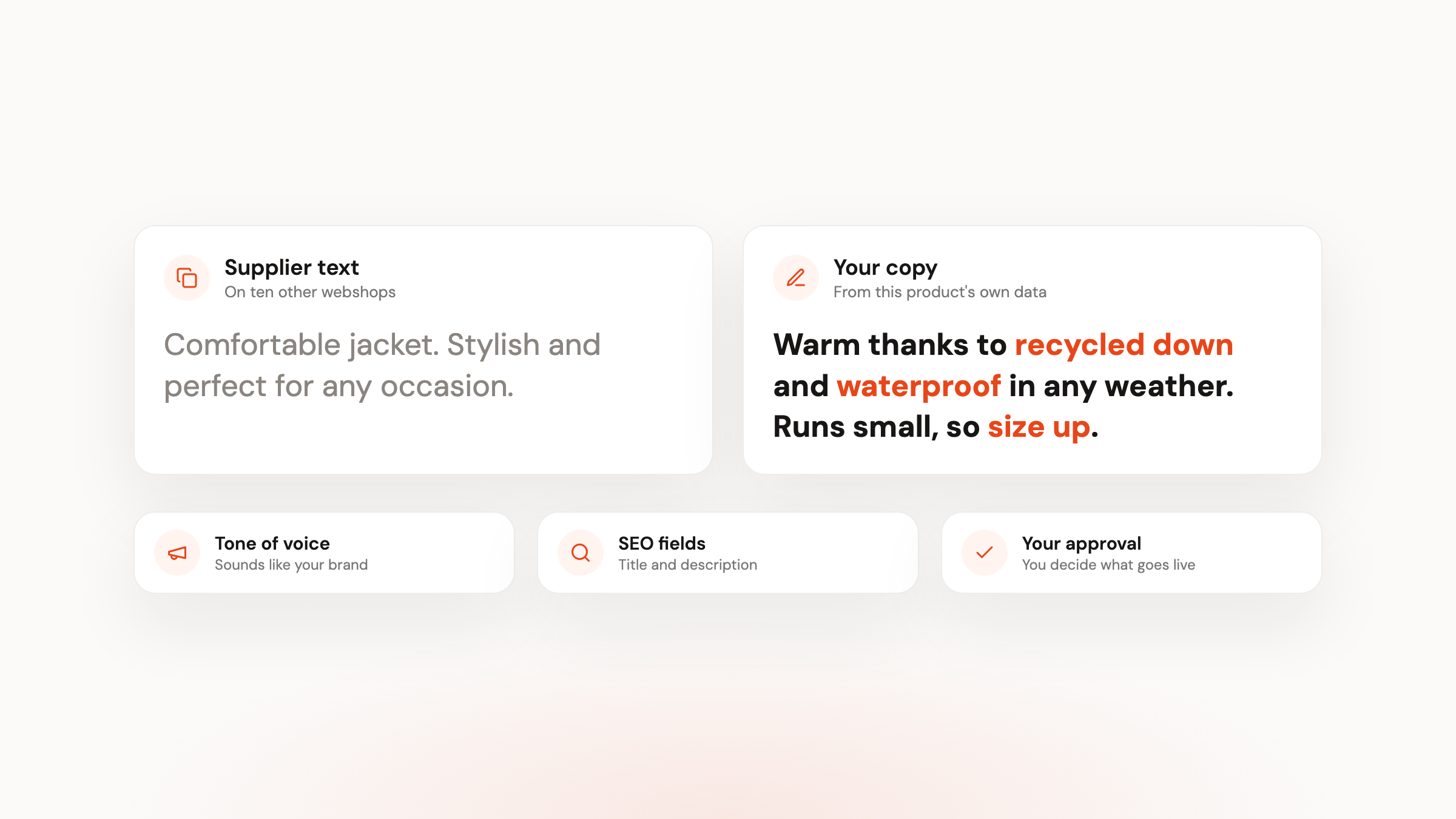
A typical supplier text starts like this: "Comfortable jacket, stylish and perfect for every occasion."
And it can look like this: "Waterproof winter jacket with recycled down. Runs small: size up if you wear a thick jumper underneath. The hood is detachable and the pockets close with a zip."
The second text names facts, answers a question customers really have and uses the words people search for. That only works if those facts are in your product data. If the system does not know the jacket has recycled down and runs small, it cannot write it either.
What should SEO product copy contain?
Use this list as a fixed structure for every text:
- The product type and its main feature, in your customer's words. Your supplier says midnight blue, your customer searches for navy.
- Material, size or dimensions and fit.
- Who or what the product is for.
- An answer to the question customers ask most, for example about size or care.
- Its own SEO title and meta description, so Google does not pick a random piece of text.
A keyword belongs in it naturally. You do not need to repeat it: once in the title and once in the copy is enough.
Why does product copy break at scale?
- Manual work cannot keep up. A good copywriter delivers quality, but not thousands of texts per season. So your bestsellers get attention, and the rest does not.
- Generic AI tools do not know your brand. Every text starts from scratch, without your tone and without your product data. Soon every jacket sounds the same.
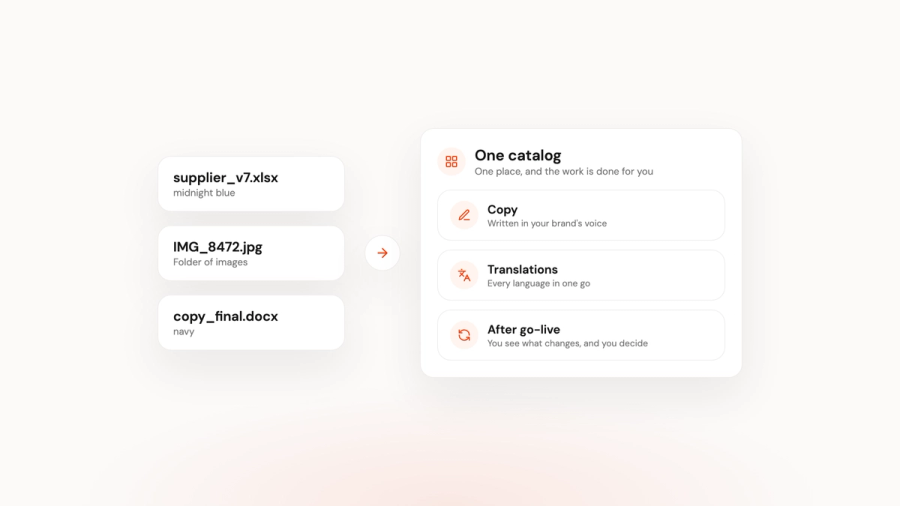
- Copy and data live apart. The copy sits in a document, the data in a spreadsheet. When the product changes, the copy stays as it was.
Where your product data is best kept, read in What is a PIM system?
Where to start this week
Start small, so you see the effect before you do the whole catalog:
- Open three products outside your bestsellers.
- Search a sentence from the copy in Google, in quotes. Does it appear on other webshops too? Then it is the supplier's text.
- Note for each product which facts are missing: material, size, fit, use.
- Write down in a few lines how your brand sounds and what every text must contain.
- Rewrite ten products with those agreements. After four weeks, check in Search Console whether they get more impressions.
Where Automated Commerce makes the difference
In Automated Commerce your product data and your copy live in the same place. Every text is written from what is known about that product, in the tone you set. That is why your catalog sounds like your brand, not like a tool.
- You set once how your brand sounds, and every text follows those agreements.
- Every product gets its own text based on its own data.
- The SEO title and meta description are created at the same time.
- You generate copy for a selection or a whole group of products, not one by one.
- You decide what goes live. Nothing reaches your webshop without your approval.
Read more about AI product copy in Automated Commerce. Collection pages work the same way, see category SEO across hundreds of brands. And once copy is live, it has to stay right: read product data quality after go-live.
Frequently asked questions
How do I write a good SEO product description?
Start with what your customer wants to know: what the product is, who it is for and what makes it different. Use concrete details such as material and fit, in the words your customer searches with. Avoid empty words like stylish and comfortable without explanation. Your own copy per product works better than the supplier's text.
Is the supplier's description good enough for my webshop?
It is a starting point, not a differentiator. The same text often appears on several webshops, so a customer or search engine has little reason to choose you. Use the data from the supplier's text, such as material and size, and write your own copy around it in your brand's tone.
Can AI write good product descriptions?
Yes, if the AI knows your product data and your brand. A standalone tool without that knowledge quickly produces copy that all sounds the same. In Automated Commerce every description is written from the data of that product and the tone you define. You decide what goes live.
How do I keep product descriptions unique across thousands of products?
Let every description start from that product's own data. Two jackets with a different material and fit then naturally get a different story. That is why good product data matters more than more writing power. If data is missing, fill it in first before you generate copy.
How do I start with AI copy without risk to my brand?
Start with a small group of products outside your bestsellers. First define how your brand sounds and what a good description contains. Then generate ten descriptions and review them critically. Adjust your agreements until it is right, and only then move on to the rest of your catalog.
Should I write the SEO title and SEO description separately?
Yes, but it doesn't have to be a separate job. The title and description decide how your page appears in search results, so they deserve their own attention. In Automated Commerce you create them together with your product copy, following the same brand agreements, so they stay consistent with the page.